
With numerous companies and products saturating the e-commerce landscape, competition has never been tougher.
Amazon is one of the main channels that offer online products. However, with over 600 million products listed on this online marketplace, getting lost in the shuffle is easy.
To resolve this, a good product is not enough. You need a good advertising strategy. That’s where Amazon Pay-Per-Click, or Amazon PPC, comes in.
However, some people may be intimidated by all the concepts needed to use this tool effectively. While it can be overwhelming initially, the benefits will be well worth it.
In this ultimate guide, we have provided all the information you need to understand Amazon PPC fully. This will allow you to use this powerful advertising model to generate sales and drive more traffic to your listings with minimal cost.
- Introduction to Amazon PPC
- Types of Amazon PPC Ads
- Setting Up Your First Amazon PPC Campaign
- Amazon PPC Campaign Structure and Terminology
- Keyword Strategy and Optimization
- Budget Management and Bid Optimization
- Analyzing PPC Performance Metrics
- Advanced PPC Tactics
- Common Mistakes to Avoid in Amazon PPC
- Final Thoughts and Best Practices
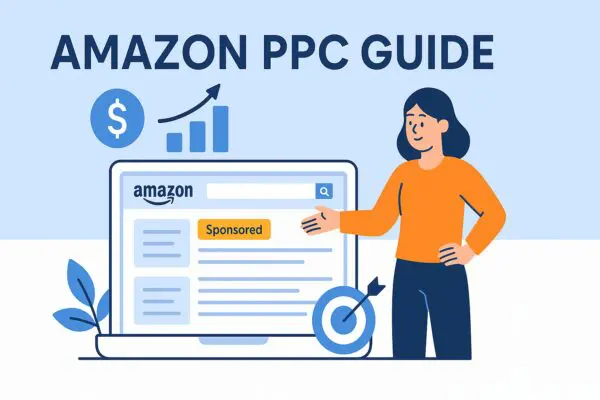
1. Introduction to Amazon PPC
What is Amazon PPC?
Amazon PPC is an advertising tool that helps businesses increase their online visibility by driving traffic to their product listings, which in turn can boost sales.
This model uses a pay-per-click scheme, where the business only pays when someone clicks on its ad. This minimizes the cost and can provide a higher ROI than other marketing strategies.
Amazon PPC allows product listings to appear in various ways, from search results on Amazon and offsite to competitors’ pages. You can also customize settings such as keywords, bid amounts, and budget.
While overwhelming for beginners, being able to navigate and execute campaigns through Amazon PPC can yield very positive results, allowing you to be more visible and ultimately driving sales figures up as well.
Why PPC Advertising Matters for Sellers
A combination of PPC and organic ranking is the best way for businesses to thrive on Amazon, especially with thousands of competitors in the same space.
In fact, it has been said that almost 80% of sellers rely on PPC advertising, proving that success without this strategy on this platform is difficult.
Those who want to stay relevant need PPC advertising to keep up with the competition. It’s not just about how much you are willing to spend, but how well you strategize to gain visibility, outperform rivals, and collect relevant data that can help you improve on future campaigns.
Amazon PPC is ideal for both new and old products, allowing businesses to invest in their brand’s growth in the world’s largest online retailer. With over 300 million people shopping on Amazon, this is an opportunity that companies surely cannot afford to miss.

2. Types of Amazon PPC Ads
Statista reports that Amazon’s global ad revenue reached over 56 billion dollars in 2024, with many expecting this number to rise in the coming years.
These figures are due to the three primary types of PPC ads, each with unique ways of targeting customers.
Sponsored Products
Sponsored products are the most popular and widely used type of ad on Amazon. These ads appear in search results and product detail pages and are primarily triggered by keywords, ASINs, or Amazon Standard Identification Numbers.
Sponsored products are ideal for individual product listings and are preferred by sellers just starting with PPC due to their ease of use. This type of ad accounts for almost 80% of all ad impressions on Amazon.
Sponsored Brands
Sponsored Brands appear at the top of search results and differ from Sponsored Products in that they primarily feature your brand rather than a specific product.
In Sponsored Brands, your brand logo appears, as well as a custom headline and multiple products under your brand. The latter can more efficiently showcase a majority of your portfolio.
Sponsored Brands is best for sellers enrolled in Amazon’s Brand Registry. It is also best for those who want instant brand recognition and visibility, as well as for those who have video ads supported by this type of sponsorship model.
Sponsored Display
Sponsored display ads are unique as they appear not only within the Amazon platform but also on external sites and apps. This gives businesses a much wider audience, especially those who have never visited Amazon before.
These types of ads use audience signals and behavioral data for targeting. This includes previous shoppers who have looked at your products or similar ones but did not result in conversion or sales.
Sponsored Displays can increase page visits and reignite interest in your product. They can also help with re-engagement and cross-selling strategies and create a wider audience reach.

3. Setting Up Your First Amazon PPC Campaign
At first glance, Amazon PPC can seem intimidating and overwhelming. However, after understanding some basic concepts, you can use this tool to launch effective campaigns and drive immediate traffic to your listings.
It can also help businesses gain valuable insights that can be used to improve their respective marketing strategies. All this begins, however, with understanding and setting up your first Amazon PPC campaign.
Choosing the Right Campaign Type
As discussed, Amazon PPC allows for three different campaign types: Sponsored Products, Sponsored Brands, and Sponsored Displays. Each has its own attributes and pros and cons.
For those just beginning to use Amazon PPC, Sponsored Products are the way to go due to their ease of use and proven effectiveness. They are also ideal for gathering keyword performance data.
If you have multiple products and once you have gathered enough experience, then Sponsored Brands is the way to go. Lastly, Sponsored Displays can be used once you are an experienced seller and if you are ready to scale up your marketing strategies.
In addition to the right campaign type, you can also choose between automatic and manual targeting. This will determine whether Amazon will choose keywords for you or if you would like to do it yourself.
It is recommended that beginners use automatic targeting at first and then switch to manual targeting once they have gathered experience and keyword data.
Keyword Research and Targeting
Keywords are critical when it comes to PPC campaigns, as they help bridge the gap between your listings and consumers through their search queries.
Tools can help find the best high-volume and relevant keywords. Examples include Helium 10, Jungle Scout, and Amazon’s Keyword Planner.
Companies must also consider different types of keywords, such as short-tail and long-tail keywords, as well as match types, which include broad, phrase, and exact.
These categorizations will help determine the competitiveness, broadness, match efficiency, effectiveness, and other factors that define the success of your keywords.
Budgeting and Bidding Strategies
Amazon PPC is not free. However, you can work with a very minimal budget. A budget is required to bid on keywords. Amazon recommends a minimum daily budget of at least $10 to generate sufficient data for better campaign strategies later.
Amazon also offers dynamic bidding options, namely down only, up and down, and fixed, which will help businesses control how aggressively their ads will compete during the bidding process.
Budgeting and bidding are skills that can be learned using a combination of data and intuition. As your experience grows, so will your ability to make more successful bids and place your ads exactly where you need to be.
Another determining factor here is ACoS, or Advertising Cost of Sales. This will help determine how profitable you are by comparing ad revenue versus ad spend.

4. Amazon PPC Campaign Structure & Terminology
One of the most confusing parts of Amazon PPC is the terminology. Many terms are used that may not be familiar to those selling items online for the first time.
Understanding the structure and terminology of Amazon PPC will help you better strategize and create more effective campaigns.
Better understanding will also allow you to analyze metrics more effectively, which will, in turn, help you improve on succeeding strategies so that you can scale and be capable of getting the results that you and your company desire.
Campaigns, Ad Groups, and Keywords Explained
Amazon PPC campaigns are organized in a hierarchy:
To fully understand the Amazon PPC structure, companies must understand campaigns, ad groups, keywords, and how they relate to each other.
Campaigns can contain different ad groups. This is also where you will define important factors such as dates, budgets, and targeting types.
Ad groups within campaigns can group similar products together and allow you to manage keywords or product targets for each individual group.
Keywords or product targets, on the other hand, are words, phrases, or other data that will instruct Amazon to trigger your ads to appear to the consumer.
Understanding this structure is integral to making Amazon PPC campaigns successful. Learn to regularly assess and restructure campaigns, ad groups, and keywords to improve ACoS figures, drive more traffic, and increase conversions.
Match Types: Broad, Phrase, Exact
Match types determine how closely search queries must match phrases’ keywords before ads are triggered. A mix of these three match types will help you balance and maximize both reach and relevance, and allow you to retrieve a treasure trove of data for future refinements.
The three main match types in Amazon PPC are as follows.
Broad Match: This will include variations and related terms. It can lead to a higher number of but less relevant traffic, but can also be used to discover new and popular keyword trends.
Exact Match: This option triggers ads only when exact keywords are entered. It can generate less traffic but will target consumers more precisely, leading to higher conversion rates.
Phrase Match: This will trigger ads if the keyword or phrase is included within the search query in the same order, but does not necessarily match exactly.
This is the sweet spot between broad match and exact match, as it provides more control and captures variety and possible new keywords.
Understanding Impressions, Clicks, and CTR
Key Performance Indicators under Amazon PPC include clicks, CTR, and impressions. Understanding these terms can help you assess the overall success of your campaigns.
It can also help you optimize future strategies for long-term performance and profitability.
Impressions define how many times your ad was shown.
Clicks define how many times people clicked on your ads.
CTR, or Click-Through Rate, defines how many of the impressions, in percentage, resulted in clicks.
The CTR is the most important figure, as it sums up your ads’ effectiveness. Don’t be surprised by low numbers, though, as the average CTR for Amazon PPC is only 0.4%, according to WebFX.
Despite this relatively low number, 0.4% is a very healthy figure. Highly optimized ads only reach 1% CTR or a little more. As a beginner, aim to reach the average and then improve slowly to increase this metric over time.

5. Keyword Strategy and Optimization
No Amazon PPC campaign can be successful without the right keywords. Choosing the appropriate keywords and phrases and refining them continuously can spell the difference between increased sales and a waste of time, effort, and money.
This section discusses how to properly create a strong keyword foundation and slowly optimize it for continuous ROI and overall performance improvement.
Manual vs. Automatic Targeting
Amazon PPC provides two options to businesses regarding keyword targeting: manual and automatic targeting.
Automatic Targeting lets Amazon decide on the keywords and products that will trigger the appearance of your ads. This is best for beginners and an effective way to gather keyword data for future campaigns.
Manual Targeting, on the other hand, lets users have free reign over keyword selection and bid amount. This is the better strategy for more advanced users, as it gives them more control over optimization and allows for more precise targeting.
Businesses can benefit from switching from automatic to manual targeting to discover high-converting search items. Then, they can filter out and refine relevant keywords to create better bids for keywords with higher potential. When done properly, this can drastically improve ACoS within months.
Negative Keywords and Their Importance
Negative keywords are keywords that you will be excluded from if users search for them. This is to prevent your ads from appearing in irrelevant or low-converting searches.
This strategy is best if your product is often confused with another irrelevant item, or if you want to exclude yourself from searches with the words “cheap” or “budget” to distinguish yourself as a more premium product.
Using negative keywords properly can result in huge savings, as it can help reduce wasted ad spend and improve CTR.
Long-Tail Keywords for Higher ROI
Long-tail keywords are phrases with longer words and are more specific in nature. These usually have lower competition and can result in higher conversion rates.
While they do not drive as much traffic as other keywords, their low bid amounts and higher CTR potential make them desirable additions to your Amazon PPC campaign.
An article from WebFX shows that 70% of Amazon search traffic comprises long-tail keywords, which proves the importance of finding, researching, testing, and refining your list of long-tail keywords to maximize traffic, ad relevance, and conversions while minimizing ACoS and overall wastage.

6. Budget Management and Bid Optimization
Budgeting is another integral part of Amazon PPC. It is necessary for optimizing bids and ensuring that your ACoS does not go through the roof.
Having a budget is critical to run campaigns, but you can do more with less if you have the right strategies and make every cent count.
How to Set a Daily Budget
A daily budget determines how much you are willing to spend on Amazon PPC campaigns daily. Many experts recommend a budget of 10 to 20 dollars a day for those just starting out.
This is enough of a daily cost to get a feel for what happens during campaigns without overwhelming your finances. It can also help you gather meaningful data during the early stages, which you can use to refine future campaigns.
Budgets can be adjusted later. You will also learn how to prioritize, especially for the best-performing keywords and campaigns with the highest potential. This is especially important as trends and customer behaviors change over time.
Adjusting Bids for Maximum Efficiency
Your bid determines how much you spend for each user who clicks on a particular keyword. The higher your bid, the higher the chances of your ads appearing based on your keywords and users’ search queries.
However, a high bid amount also increases the cost-per-click, or CPC. This can dramatically affect your KPIs, specifically your ACoS.
As such, balancing competitiveness and profitability is essential. Learning about these three bidding strategies available on Amazon PPC can dictate whether this delicate balance can be met.
Dynamic Bids – Down Only: Amazon PPC will automatically lower your bid amount if conversion is less likely.
Dynamic Bids—Up and Down: This is similar to the above, but Amazon will also raise or lower bids depending on conversion likelihood.
Fixed Bids: Your bid remains unchanged based on initial settings
Those on a budget can begin using the Down Only strategy and then move to Up and Down once more data can be retrieved. For those with more confidence in their judgement, Fixed Bids can be the best option.
Using Dynamic Bidding Options
Dynamic bidding uses Amazon’s real-time data to increase your ad efficiency. When used properly, it helps ensure you’re paying more for high-value opportunities and conserving budget during low-conversion scenarios.
Over time, consistent bid optimization helps improve ACoS (Advertising Cost of Sales), maximize visibility for winning keywords, and reduce wasted ad spend.

7. Analyzing PPC Performance Metrics
Performance metrics can be seen during and after a campaign. It is important to be able to analyze and interpret this data, as it will help make informed decisions moving forward.
Below are just some of the performance metrics that you need to know about and examine to create better and more effective campaigns.
Key Metrics to Monitor (ACoS, ROAS, CTR)
ACoS (Advertising Cost of Sales): Measures how much is spent to generate $1 in sales. This figure is represented by a percentage, with lower numbers reflecting better results.
A 10% ACoS, for example, means that for every $1 in sales, $0.25 is spent on ads.
ROAS (Return on Ad Spend): This measures how much revenue is earned for every dollar spent on ads. This figure is represented in dollars; the higher the number, the better.
For example, a ROAS of 10.0 means that there is an ROI of $10 in revenue for every $1 spent on ads.
CTR (Click-Through Rate): This is the number of people who click on your ads once they are displayed, represented by percentages.
A CTR of 1% means that, for every 100 times your ad is shown, one user clicks on it. CTRs on Amazon typically range between 0.3% and 0.5%, with top-performing sellers getting up to 1% CTR or more.
In addition to these three, you can also see metrics such as Cost-Per-Click, Impressions, and Conversion Rates. These, however, are directly related to the above and are less critical than ACoS, ROAS, and CTR.
Interpreting Reports and Search Term Data
One of the most important reports you can get is the Search Term Report. This report provides businesses with important information that can be used to optimize campaigns.
The Search Term Report includes data such as which customer search queries triggered ads and performance data for each term.
This information can be used to identify which terms generate the highest conversions and which ones perform poorly. It can also be used to determine irrelevant terms and add them as negative keywords.
In addition, it can be used to adjust bids and manually target keywords, among other critical decisions you can make to make your campaigns more effective and profitable.
Tools for Performance Analysis
The Amazon Advertising Console is a powerful tool that has been built into the Amazon platform. However, you may also use third-party applications such as Helium 10 or Perpetua.
These tools provide metrics and other insights, as well as automation features, that can make maintaining Amazon PPC campaigns more convenient.
Using PPC analytic tools will provide businesses with important information and can make adjusting campaign settings easier. This can result in lower costs and increased revenue through more effective ads.

8. Advanced PPC Tactics
Once you have launched your first few campaigns and gathered enough experience, it is time to step it up a notch. Below are some advanced tactics that can take your Amazon PPC campaigns to the next level.
This is best for highly competitive markets or if you are ready to scale, enhance brand recognition, and further improve on the metrics that you are currently getting.
Retargeting and Product Targeting
Retargeting through Sponsored Display ads and product targeting are two ways to increase revenue.
Using Sponsored Display ads to show ads to shoppers who have previously viewed your products or similar items but did not continue with the purchase can keep you at the top of mind and can help increase conversion rates.
In fact, a study by Invesp shows that consumers who are shown retargeted ads within a week are 70% more likely to make a purchase than those who see the same product organically at a later time.
On the other hand, product retargeting entails placing ads on listings of similar products from competitors. This is an effective way to “ride off” the competition and to hijack market share. It is also a good way to introduce your brand to those who are not yet familiar with it.
Dayparting and Geo-Targeting
Dayparting involves scheduling your ads to appear only during certain parts of the day. Ideally, ads should appear during peak conversion hours, such as at night when consumers are just browsing online.
Amazon does not have native support for dayparting, although third-party tools such as Perpetua and PPC Entourage can automate this process.
Meanwhile, geo-targeting will allow businesses to focus ads on high-performing regions or locations. This is best for popular products in a certain country or during a particular season.
Examples are winter clothes, food, and other popular items in specific locations or cultures.
Using these two strategies will allow you to stretch your budget by maximizing ad spend on those schedules and locations that can generate higher sales while minimizing expenses during less favorable times and across demographics with low potential for conversions.
Leveraging Amazon DSP for Broader Reach
For companies ready to scale and level up their respective campaigns, Amazon DSP, or Demand Side Platform, offers more advanced capabilities, including but not limited to audience segmentation and advanced targeting options.
This platform is best for established brands that want to expand their reach across channels such as third-party apps and other sites outside of the Amazon ecosystem.
Amazon DSP is best used in conjunction with Sponsored Ads and can improve brand recognition, which can, in turn, lead to conversions and sales in the long run.

9. Common Mistakes to Avoid in Amazon PPC
No matter how well thought out, campaigns can be easily derailed if there are flaws in either strategy or execution. Unfortunately, many of these are common mistakes that even experienced sellers commit.
Mitigating these mistakes can have a positive impact on your campaigns, minimizing wastage and maximizing earning potential. On the other hand, continuing with these bad practices can result in wastage and slow brand growth.
Overspending Without Performance Tracking
It is very important to monitor your budget. Letting it run unchecked without analyzing metrics such as ACoS, CTR, and conversion rates can quickly spell disaster for your campaigns.
Remember to check your metrics and adjust bids and other settings based on the performance of your keywords. This must be done at least weekly so that you can maximize your budget and ensure that you are getting the ROI that you want.
It can be easy to overlook how much you are spending on ads, yet it is one of the most critical aspects of any Amazon PPC campaign and can determine how profitable ads are for every dollar spent.
Ignoring Negative Keywords
Negative keywords are another important aspect of Amazon PPC, as they help filter out ads to consumers who may see these ads as unnecessary or irrelevant.
Not including negative keywords in your setup can result in low click-through rates that will waste your precious budget and not lead to conversions.
As such, it is essential to check the performance of keywords on a regular basis. If certain keywords are not performing well, then it might be time to include them in your negative keywords list.
Poor Campaign Structure
Disregarding proper campaign structure can spell disaster, causing wastage and lost opportunities in terms of brand visibility and conversions.
Businesses should properly organize campaigns by grouping related products together. Not doing this can make optimization nearly impossible and lead to confusion about which products or keywords are performing well.
Sellers should remember to group products according to themes. It would be better to run separate ad groups for products that belong in separate categories rather than clumping them together in one group.
Proper campaign structure ensures that you can have segmented campaigns, which will yield easily understood results, as well as ads that are shown to consumers with higher relevance and can provide better conversion results.

10. Final Thoughts and Best Practices
The best way to think of Amazon PPC is as an organic being. It needs to survive and adapt, and it needs to be constantly maintained and refined according to changing trends and algorithms.
As such, mastering best practices such as the ones listed below is integral to maintaining gains and improving upon past KPIs. This means aiming for higher CTR, lower ACoS, and increased sales volume for each succeeding campaign.
Consistent Monitoring and Optimization
Those responsible for Amazon PPC campaigns should be flexible and adapt quickly to factors such as changing customer behavior, buying seasons, or increased competition.
It is recommended that regular check-ins be conducted and that operations such as adjusting keyword selections, reallocating budgets to those with higher conversion history and potential, adding new negative keywords, and others be performed.
Decisions that will determine changes will be based on KPIs such as ACoS, CTR, and conversion rates.
Sellers can experience better returns when making regular adjustments rather than those that set and forget, so ensure to adapt based on data regularly to improve metrics further.
Testing New Strategies
Testing is an integral part of Amazon PPC, as it is always better to see performance in an actual environment rather than a theoretical one.
Experimentation and A/B testing can be done against different strategies, such as:
- Dynamic bidding vs. Fixed bidding
- Exact vs. Phrase vs. Broad Match Types
- Manual vs. Automatic Campaigns
Testing one variable at a time can provide valuable insights into possible adjustments that can drive better results.
Staying Updated with Amazon Ad Trends
Aside from changing trends and other external factors, businesses should also consider that Amazon itself regularly updates its ad platform and algorithm. With this update come new features and rules for displaying ads.
Keeping updated on these changes can give you an edge as you can adapt quickly while competitors lag behind.
To stay current with Amazon PPC’s regular updates, it is recommended that you subscribe to the Amazon Ads newsletter, join communities (Reddit, LinkedIn, Substack, etc.), and attend webinars focused on Amazon PPC.
Continuous learning and adaptation, as well as using data to make informed decisions, can result in long-term success for businesses using Amazon PPC.
Conclusion
Amazon PPC is not just about ads but rather creating effective strategies and balancing cost and potential revenue. It also means utilizing gathered data to make more informed decisions that can help you grow your brand further.
With millions of products and thousands of online sellers on Amazon, staying ahead of the competition is important. Running effective Amazon PPC strategies can help immensely in ranking, presence, and sales.
Perhaps more importantly, it can also provide critical insights about customer behavior that you can use and adapt to, giving you that crucial edge over others competing in the same space.
Of course, constant tweaking and evolution, along with changing trends, are important. This is why Amazon PPC is not a set-and-forget approach. Continue to test and refine to maintain and improve results.
Remember: with Amazon PPC, the rule of the game is not to spend more but to spend wiser. With the tips and tactics included in this guide and proper planning, you will be well-armed with the knowledge to run successful Amazon PPC campaigns that can get you the results you want.
